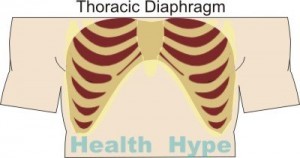
Diaphragm (Human Thorax) Location, Anatomy, Function and Position
The Human Diaphragm The word ‘diaphragm’ is used to describe several structures in the human body and in particular the thoracic, urogenital and pelvic diaphragms. The most important and largest of these structures is the thoracic diaphragm. It is a flat sheet of muscle that is responsible for breathing. The diaphragm essentially pulls and pushes against the lung causing it to expand with inhalation and contract with exhalation. The thoracic diaphragm also separates the organs in the thoracic cavity (chest) and abdominal (belly). By separating these cavities, the important organs like the lungs and heart can function properly in its own compartments. Some organs like the large blood vessels and esophagus (food pipe) pass across the diaphragm between the chest and belly through different openings. In this way the chest and abdomen can communicate with each other only at certain points. Anatomy of the Diaphragm The thoracic diaphragm is essentially a large muscle. Like all muscles, it has tendons that attach to the muscles and secure it. The diaphragm is attached to the inside of the ribs, to the back of the breastbone and the spine. The muscle fibers then meet in the middle of the diaphragm at the central … Continue reading Diaphragm (Human Thorax) Location, Anatomy, Function and Position
